
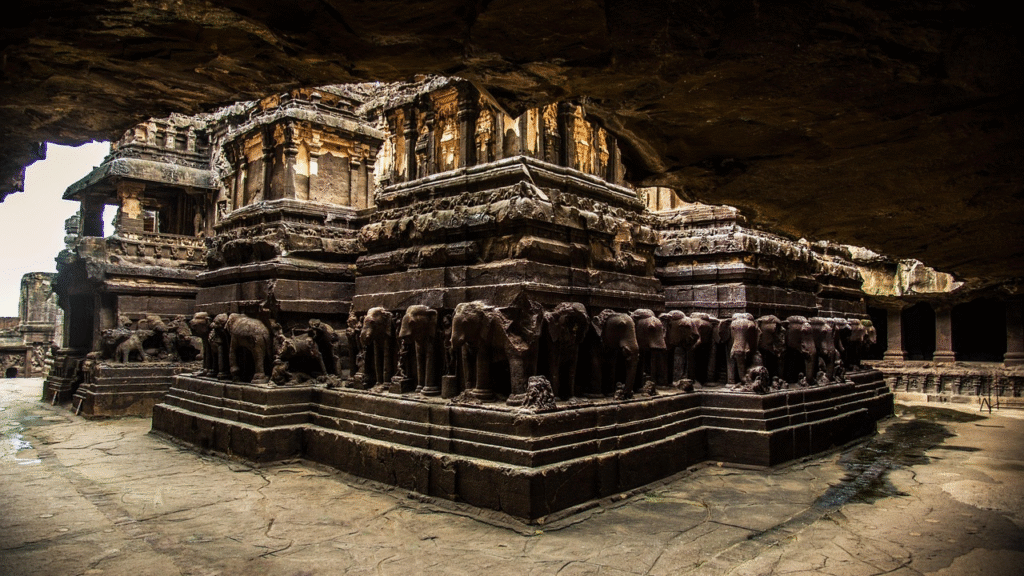
Located in Ellora Caves, Maharashtra, the Kailashanatha Temple—also known as Kailasa Temple (Cave 16)—stands as an awe‑inspiring testament to ancient monolithic architecture. Carved wholly from a single basalt cliff, this temple is dedicated to Lord Shiva, symbolizing Mount Kailash, his mythic abode. It is widely recognized as the world’s largest single‑rock excavation and a UNESCO World Heritage gem (Wikipedia).
Constructed between 756 and 773 CE under Rashtrakuta King Krishna I, the temple blends artistic excellence with spiritual symbolism, making it one of the most iconic heritage sites in India (Chegg India).
| Temple Name | Kailashanatha Temple (Kailasa Temple, Cave 16) |
| Location | Ellora Caves, near Aurangabad, Maharashtra, India |
| Built By | Rashtrakuta King Krishna I |
| Time Period | Circa 756–773 CE |
| Architecture Style | Dravidian rock-cut monolithic architecture |
| Unique Feature | Entirely carved from a single rock; top-down excavation |
| Dimensions | 195 ft long, 145 ft wide, 100 ft high |
| Dedicated To | Lord Shiva (symbolic representation of Mount Kailash) |
| Highlights | Nandi Mandapa, sculptures from Ramayana & Mahabharata, Ravana lifting Kailash, Ardhanarishvara, Ganga-Yamuna-Saraswati carvings |
| Spiritual Significance | Sacred Shaivite site, worship of Shiva Linga continues today |
| UNESCO Status | Part of the Ellora Caves, a UNESCO World Heritage Site |
| Construction Method | Top-down excavation using only basic tools; estimated 200,000–400,000 tons of rock removed |
| Resilience | Withstood destruction attempts by Mughal emperor Aurangzeb |
| Timings | 6:00 AM to 6:00 PM daily; closed on Tuesdays |
| Best Time to Visit | October to March (cooler weather, less crowd on weekdays) |
| Entry Fee | Approx. ₹10 (Indian citizens), $10 (foreign tourists) |
| How to Reach | 30 km from Aurangabad; accessible by road, bus, taxi |
| Cultural Importance | Influenced Deccan temple architecture; one of India’s finest architectural and spiritual heritage monuments |
| Modern Appeal | Architectural marvel, photo-friendly site, popular among heritage, culture, and architecture enthusiasts |
An Architectural Marvel: Carved from One Rock
What makes Kailasha Temple truly extraordinary is that it was excavated top‑down from the basalt cliff—an architectural feat rarely seen elsewhere. Approximately 200,000 to 400,000 tonnes of rock were painstakingly removed using only hand tools over about 18 years. The level of precision and planning remains a mystery even to modern engineers (Trawell.in).
The temple covers roughly 195 ft in length, 145 ft in width, and rises to a height of nearly 100 ft, encompassing a courtyard, corridors, a Nandi pavilion, mandapas, and the inner sanctum—all carved from a single stone mass (Tripoto).
Layout & Sculptural Grandeur
The temple complex includes a vast U‑shaped courtyard, edged by arcaded galleries on two stories, lined with sculpted niches and mythological frescoes depicting scenes from the Ramayana and Mahabharata (Wikipedia, nvli.in).
At the entrance stand monolithic elephants and lions, carved to appear as though they are supporting the structure, symbolizing the strength and dignity of the Rashtrakuta kings (nvli.in).
Inside, the Nandi Mandapa, crowned with a 45‑ft pillar, is connected by a rock bridge to the inner shrine. The shrine houses the Shiva Linga, with a flat‑roof mandapa supported by 16 pillars and all elements carved with elaborate detail, including erotic mithuna figures, deities, and admiring divine beings (Novatr).
Myth, Legend & Religious Symbolism
Kailash Temple is a symbolic re‑creation of Mount Kailash, Shiva’s heavenly abode, reinforcing its Shaivite significance. Myth recounts that the temple was initially named Manikeshwar and built at lightning speed to fulfill a queen’s vow—crafted so perfectly she saw its shikhara within days of the start of works (Chegg India).
A famous relief called Ravananugraha shows Ravana attempting to lift Mount Kailash—a dramatic narrative captured in astonishing detail. Nearby sculptures include Ardhanarishvara, Mahishasuramardini, and the representations of river goddesses—Ganga, Yamuna, Saraswati—whose shrines flank the main corridor (Wikipedia).
Engineering Wonder
The precision in execution remains equally astonishing. The temple includes drainage systems, ventilation, and careful orientation toward the rising sun. The scale, symmetry, and sheer scale—accomplished with basic tools—continue to astonish architects and scholars alike (Novatr).
Attempts at destruction, most notably ordered by Emperor Aurangzeb, were unsuccessful—even after three years of effort by 1,000 labourers, who could only partially deface some sculptures. The temple’s resilience underscores its solid monolithic strength (Trawell.in).
Spiritual Importance
As a sacred shrine to Lord Shiva, Kailashanatha Temple remains a revered site of Shaiva worship. The central sanctum houses a prominent Shiva Linga, which continues to be worshipped in a setting ripe with divine symbolism. The surrounding carvings reinforce stories of divine victory, cosmic order, and mythic ecology, blending religious experience with architectural storytelling (Tripoto, Wikipedia).
Visiting Today: Tips & Logistics
The temple is open daily from 6:00 AM to 6:00 PM, and entry is restricted on Tuesdays (optimatravels.com). Entry tickets cost approximately INR 10 for Indians and USD 10 for foreign tourists (optimatravels.com).
The site is located about 30 km from Aurangabad, which is well connected by road, rail, and flights. Visitors can select local buses or taxis to reach the Ellora Caves site in approximately 45 minutes (theindianarchitecture.com).
Best visiting time is during the cool season from October to March, with early morning entries advised to avoid crowds and summer heat. Weekdays tend to be less crowded, and early hours offer the best light for photographs and contemplation (Reddit, Reddit).
Legacy & Cultural Resonance
The Kailashanatha Temple remains one of the greatest achievements of rock‑cut architecture, celebrated internationally for its scale and artistry. Art historians frequently liken its importance to masterpieces like the Parthenon, even noting that the temple’s area exceeds twice that of the Parthenon in Greece (Trawell.in).
The temple influenced later Deccan architecture and remains a central site of Shaiva tradition, pilgrimage and heritage preservation.

